


What Labubu can teach startups about strategic brand mastery



Born from Hong Kong’s Pop Mart, Labubu is an oddly adorable toy that’s more than merch. It’s a cultural phenomenon.
Labubu is triggering global sellouts, fuelling resale frenzies and building a fanbase with near-religious devotion. Fans camp out for new releases. TikTok is flooded with unboxings and trades. Resellers flip rare pieces for thousands of dollars. This isn’t just fandom. It’s cult commerce at its finest, catapulting founder and CEO Wang Ning’s net worth $1.6 billion in a single day.
But this isn’t about toys.
It’s about strategy. An intentional, repeatable way to build a brand that doesn’t just grab attention – it creates a world people want to come back to, again and again.
If you’re building a commerce brand, this is the playbook for turning products into moments, customers into a community and a brand into a movement.
Because the most powerful brands don’t sell. They invite people into something bigger.
Here’s how Labubu did it:
Labubu didn’t invent the wave, it joined the pendants and bag‑charm trend and turned it into its own emotional ecosystem. When celebrities like Blackpink’s Lisa and Rihanna showcase a blind‑box figure dangling from their bags, the impact explodes driving instant sell-outs.
That’s the lesson: You don’t have to invent the wave. You just have to ride it differently.
Take the current micro-trend of mini pendants on handbags, phones, and keychains. Now imagine a founder launching a tiny, collectible wellness mascot, a charm that doubles as a lip balm, a mantra, or a daily affirmation. Cute, collectible, emotionally sticky and layered with Labubu’s mystery-drop model you have a viral formula:
Steal what’s already working. Add narrative. Make it personal.
Labubu’s magic isn’t the figurine – it’s the universe around it. From blind‑box drops to character evolution, community trades and TikTok unboxings (#Labubu has millions of views), it functions as a portal into a shared cultural space.
What makes it work:
Lifestyle brand founders can do the same whether it’s a skincare line, a wellness product, or a fashion drop – any vertical can replicate this:
Labubu isn’t simply purchased – it’s pursued. It’s not about clicking “buy now”; it’s about earning access, being part of a moment and owning something that not everyone can.
Think mystery boxes. Limited drops. Randomised unboxings.
These aren’t just gimmicks, they’re emotional accelerants. And when paired with compelling storytelling, they unlock $7,000+ resale prices, app-topping launches, global queues and a kind of brand devotion money can’t buy.
Why it works:
Apply this:
You don’t need massive inventory. You need intention.
Virality is seductive. But it’s also dangerous.
One-hit wonders burn fast and fade faster and in today’s attention economy, hype without depth is a short-lived game. Here’s where 99 per cent of viral brands fail, they chase a moment but don’t build staying power.
Labubu dodged this. It could have been just another TikTok trend – a flash of dopamine and done.
Instead, it’s building: expanding into jewellery, forums, artist collaborations, functional products and storytelling arcs that keep fans emotionally invested.
Trends fade fast. Brands that survive build ecosystems: narrative arcs, brand alliances, owned communities, cross-category evolution.
That’s the real lesson: Cult brands don’t chase moments – they create ecosystems.
This is how you turn virality into longevity:
As a founder, you’re not just launching a product – you’re architecting a brand world.
Ask yourself:
Because hype can get you noticed. But homes, brands that feel like creative, connected spaces keep people coming back. Build a brand your customers never want to leave.
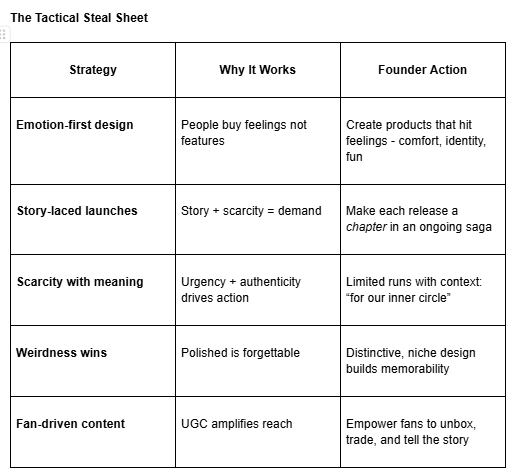
Here’s the Labubu playbook broken down into real, repeatable tactics for women building brands today:
The success of brands that have had a similar strategy in the toy market is eye boggling:
These are not anomalies – they are evidence. Brands that combine scarcity, emotion, community, and strategy create real capital.
Labubu isn’t quirky fluff – it’s strategic mastery. It shows how trend-savvy brand builders can cultivate emotional resonance, convert scarcity into connection and build universes people choose to inhabit.
For founders ready to break the mould: don’t ask “What should I launch?”
Ask: What universe am I inviting my customer to live in?

Dr TJ Thomson is a senior lecturer in visual communication and digital media at RMIT and an Australian Research Council DECRA Fellow (2023-26). T.J.’s research is united by its focus on visual communication. A majority of his research centres on the visual aspects of news and journalism and on the concerns and processes relevant to those who make, edit, and present visual news. Prof. Daniel Angus is Professor of Digital Communication in the School of Communication, and Director of QUT’s Digital Media Research Centre. Daniel’s research examines issues at the intersection of technology and society, with a focus on artificial intelligence, automation, misinformation, and new methods to study the digital society.


Comments